

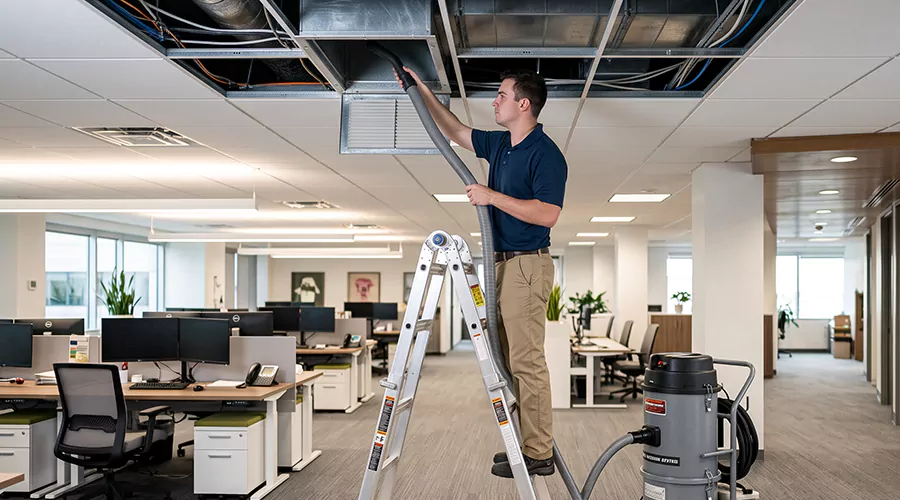
Commercial air duct cleaning is often budgeted at approximately $0.30 to $0.50 per square foot in published U.S. estimating guides, although there is no standard nationwide rate. Using that range, cleaning a 10,000-square-foot commercial building may cost approximately $3,000 to $5,000. Larger buildings and complicated HVAC systems can cost substantially more, depending on the ductwork and work included.
Commercial duct cleaning removes accumulated dust and debris from the ventilation systems serving offices, retail stores, warehouses, hotels, and other commercial properties. Unlike a typical residential system, commercial HVAC equipment may supply air to several floors or independently controlled zones. The ductwork can also include large main trunks, variable air volume boxes, and multiple air-handling units.
Because commercial systems vary widely, floor area alone cannot determine the final cleaning price. A building with large open spaces may have less ductwork per square foot than an office containing numerous individual rooms. Access restrictions and the number of air-handling units can also affect labor and equipment requirements.
A reliable estimate should be based on the actual ventilation system, the condition of its components, and a written cleaning scope. Understanding how commercial cleaning prices are calculated helps property owners and facility managers develop realistic budgets and compare contractors.
What Is the Average Commercial Air Duct Cleaning Cost in 2026?
Commercial air duct cleaning does not have a single reliable national average because projects vary from small office systems to large institutional ventilation networks. One published U.S. commercial pricing guide uses approximately $0.30 to $0.50 per building square foot as a preliminary budget. These figures are editorial estimates and should not be confused with verified nationwide transaction averages.
For a smaller commercial building, a contractor may offer a fixed price after inspecting the ductwork. Larger facilities often require an individual proposal based on the air-handling equipment, duct layout, cleaning access, and operating schedule. Specialized projects involving hospitals or difficult industrial environments may cost considerably more than a simple square-foot calculation suggests.
The following table illustrates the $0.30 to $0.50 per-square-foot pricing model.
| Commercial Building Size | Illustrative Cleaning Budget |
|---|---|
| 2,000 square feet | 600–1,000 |
| 5,000 square feet | 1,500–2,500 |
| 10,000 square feet | 3,000–5,000 |
| 15,000 square feet | 4,500–7,500 |
| 25,000 square feet | 7,500–12,500 |
| 50,000 square feet | 15,000–25,000 |
These figures are calculations based on one published estimating range, not guaranteed contractor quotes. They also assume the same rate across different building sizes, which may not reflect the actual cost of large or complicated systems. The amount of ductwork and equipment included must be established before a dependable price can be offered.
A cleaning quote should specify whether the work includes supply and return ducts, main trunks, air-handling units, and other affected components. Otherwise, two contractors may appear to quote the same service while including very different amounts of work.
How Is Commercial Duct Cleaning Priced?
Commercial duct cleaning companies may calculate prices using floor area, duct dimensions, equipment counts, or estimated labor. Each approach has advantages, but no single method captures every aspect of a building's ventilation system. The project scope and final total are more useful than the pricing formula alone.
Pricing per Square Foot
Square-foot pricing uses the building's floor area as a starting point. It is convenient for preliminary budgeting because the property owner usually knows the total square footage. This method works best when the building's HVAC layout is reasonably typical for its use.
However, floor area is not the same as duct surface area. A large warehouse may have relatively few main ducts, while an office of the same size may contain many branch connections and terminals. The contractor should confirm whether the quoted rate reflects the actual system.
Pricing by Duct Surface Area
Some commercial contractors estimate work based on the amount of internal duct surface requiring cleaning. This considers duct dimensions and lengths rather than the area of the occupied rooms. It can be useful when cleaning only selected ducts or when the building contains unusually large passages.
For example, a wide rectangular duct contains more internal surface than a smaller round duct of the same length. The cleaning method and access requirements can also differ. Accurate drawings and an inspection help establish what needs to be measured.
Pricing by Air-Handling Unit
Commercial buildings may contain several air-handling units serving independent areas or floors. Each unit can require separate inspection, preparation, and cleaning. Contractors may therefore account for the number and size of air-handling units when preparing a quote.
The equipment scope matters because cleaning an air handler can involve blowers, coils, internal cabinet surfaces, and condensate components. This is different from cleaning the connected ducts alone. A quote should state which equipment components are included.
Hourly or Project-Based Pricing
Some contractors calculate labor and equipment costs before presenting a fixed project price. Complicated projects may also involve separate charges for work performed outside normal business hours. The required crew size and access equipment can influence the estimate.
A project-based quote is useful when it clearly defines the work and completion criteria. Property managers should ask how unexpected conditions will be handled. Additional cleaning or repairs should be approved before they create new charges.
What Factors Affect Commercial Duct Cleaning Costs?
The size of the property is only one factor influencing commercial duct cleaning prices. The number of HVAC systems and the complexity of the duct network often have a greater effect. Accessibility and contamination conditions can also change the amount of work required.
Building Size and Layout
Larger buildings commonly contain more ductwork, but the relationship is not consistent across property types. A multistory office with many enclosed rooms may contain more branches and terminals than an open industrial space. Each additional section creates cleaning and inspection work.
The floor plan also affects access. A building with removable ceiling panels may provide easier access to some duct sections than one with permanently finished ceilings. A contractor should review the layout before assuming that square footage alone determines labor.
Number of Air-Handling Units
A facility with multiple air-handling units generally needs more preparation and cleaning than a property served by one system. The units may have different sizes and service requirements. Some may also be installed in rooftop mechanical areas while others occupy indoor equipment rooms.
Cleaning each system independently can require additional setup time. The contractor should identify every unit included in the proposal and explain whether associated ducts are also covered. This prevents significant portions of the system from being overlooked.
Duct Size and Material
Large commercial ducts may require specialized equipment and suitably placed access openings. Internally lined metal ducts and fiberglass duct board require gentler methods than sound bare sheet metal. Improper brushing can damage these materials and release fibers.
The National Air Duct Cleaners Association's ACR standard provides procedures for assessing and cleaning different HVAC components. A contractor should select equipment based on the actual duct construction rather than use one aggressive method throughout the building.
Ceiling Height and Access
High ceilings can increase cleaning costs because workers may need lifts or other approved access equipment. Ducts installed above finished ceilings may also be difficult to reach without removing access panels. The work may need to be coordinated around lighting, fire protection, and other building systems.
Working around occupied offices can further affect access. Furniture and tenant activities may limit the available working area. Planning access in advance can reduce delays and unexpected labor charges.
Amount and Type of Contamination
Dry dust and ordinary debris can often be removed using appropriate source-removal methods. Heavy construction debris or contamination from pests may require additional work. Water-damaged insulation and suspected mold present different problems because cleaning may not restore every affected material.
The condition should be documented before specialized remediation is proposed. A musty smell or dark deposit does not automatically prove that the entire HVAC system contains mold. The contractor should identify the affected surfaces and underlying cause.
After-Hours Work
Some facilities cannot interrupt heating or cooling during normal operating hours. Restaurants, hotels, office buildings, and medical facilities may require cleaning during evenings or scheduled shutdown periods. These restrictions can increase labor and coordination costs.
After-hours work may also require additional security access or building staff. The estimate should identify these requirements. Scheduling the work in planned phases can help reduce disruption while maintaining safe conditions.
How Much Does Commercial Duct Cleaning Cost by Building Type?
Different commercial properties have different ventilation requirements. The number of zones and the equipment serving them can affect cleaning complexity. A building's use can also determine when work is permitted and what protective measures are needed.
| Building Type | Main Cost Considerations |
|---|---|
| Small office | Number of branches and air-handling units |
| Large office building | Multiple floors, zones, and VAV terminals |
| Retail store | High ceilings and customer access restrictions |
| Warehouse | Large duct sections and elevated equipment |
| Hotel | Guest-room access and phased cleaning |
| Restaurant | Supply and return systems plus separate kitchen exhaust considerations |
| School | Numerous rooms and occupied-hour restrictions |
| Hospital | Infection-control requirements and specialized HVAC systems |
| Industrial building | Process-related contamination and access conditions |
A hospital project may require additional coordination and environmental controls beyond ordinary office cleaning. Industrial facilities can also contain contaminants unsuitable for conventional HVAC duct-cleaning methods. These conditions require a site-specific plan rather than standard residential assumptions.
Commercial kitchen grease exhaust is a separate system that should not be confused with ordinary HVAC supply and return ducts. Its cleaning requirements are different because grease accumulation creates a distinct fire hazard. The contractor should identify which systems the proposal covers.
What Does Commercial HVAC Duct Cleaning Include?
A commercial cleaning project should have a defined scope based on inspection findings. Cleaning may include supply ducts, return ducts, air-handling units, registers, and other affected components. The contractor should identify the intended cleanliness criteria before beginning work.
Common components include:
- Supply air ducts and branch connections.
- Return air ducts and main return passages.
- Registers, grilles, and ceiling diffusers.
- Main supply and return trunks.
- Air-handling unit cabinet interiors.
- Blower wheels and housings when included.
- Coils and condensate components when appropriate.
- VAV boxes and other terminal equipment within scope.
- Accessible dampers and related air-volume devices.
- Exhaust systems specifically identified in the contract.
This is a list of possible scope items, not a requirement to clean every component regardless of condition. The project should address the contamination actually found. Equipment repairs and replacement work should be documented separately.
Professional source removal typically uses suitable agitation tools while vacuum equipment collects loosened debris. Temporary access openings should be restored after cleaning, and the duct system should remain airtight.
What Additional Costs Can Increase a Commercial Cleaning Quote?
A contractor may discover damaged components or conditions requiring work beyond routine dust removal. For example, a disconnected duct joint may need repair before cleaning can continue. A water-damaged fiberglass liner may require replacement rather than aggressive brushing.
Other possible cost additions include specialized access equipment, after-hours labor, ceiling restoration, and additional inspection work. Pest remediation and hazardous-material assessment are separate services when those conditions exist. The proposal should explain how these situations will be handled.
Chemical treatments should not be included automatically. A company proposing antimicrobial application should identify the specific reason and verify that the product is authorized for the intended HVAC surface and application method. Physical dust removal is not replaced by spraying a chemical into the ducts.
When Does a Commercial Building Need Duct Cleaning?
Commercial duct cleaning is most appropriate when an inspection identifies substantial deposits or contamination requiring removal. Construction work can introduce debris into the system, while moisture problems may affect certain components. The actual need depends on building conditions rather than floor area alone.
NADCA recommends regular cleanliness inspections of commercial HVAC systems as part of a maintenance program. Inspection intervals are different from cleaning intervals. Finding ordinary dust does not automatically mean that a complete cleaning project must be scheduled.
Building managers should also investigate recurring deposits around returns or damaged duct connections. A leak drawing air from a dusty mechanical space can cause repeated contamination. Correcting the source may be more useful than repeatedly cleaning the same system.
How Long Does Commercial Air Duct Cleaning Take?
Commercial duct cleaning may take one working day for a small accessible system or several days for a large facility. Complicated multistory projects can require phased cleaning over a longer period. The actual schedule depends on equipment counts and how much work can be completed during each shutdown.
A contractor should prepare a project schedule identifying affected areas and anticipated interruptions. Cleaning may need to occur zone by zone so unaffected systems remain available where permitted. This is particularly important for buildings with strict operating requirements.
The time estimate should also include preparation and verification. Removing debris is only part of the project. Safe access, protection of occupied areas, and restoration of the HVAC system are necessary for proper completion.
How Can You Compare Commercial Duct Cleaning Quotes?
The best comparison is based on a consistent written scope rather than the lowest square-foot price. Contractors should inspect the building and identify which systems are included. An inexpensive quote that excludes major ducts or air-handling units may not provide the required service.
Request the following information:
- The number of HVAC systems and air-handling units included.
- Supply and return duct sections covered.
- Whether VAV boxes and other terminal equipment are included.
- Cleaning methods and debris collection procedures.
- Required access openings and restoration work.
- Equipment and personnel needed for elevated areas.
- Occupant protection and shutdown arrangements.
- Procedures for damaged or contaminated materials.
- Post-cleaning inspection and verification methods.
- Project schedule and potential additional charges.
A qualified contractor should be able to explain the cleaning methods and limitations. NADCA's commercial specifications and current ACR standard provide useful benchmarks for evaluating the scope. The final proposal should reflect the specific building rather than simply reproduce a generic checklist.
How Often Should Commercial Air Ducts Be Cleaned?
Commercial ducts do not need cleaning automatically every year. NADCA recommends periodic inspections to evaluate cleanliness, but the actual cleaning schedule depends on the findings. Building use and operating conditions influence how quickly deposits accumulate.
A building undergoing frequent renovation may require inspections after construction activities. Facilities containing industrial dust or other process-related contaminants may need a more specialized maintenance plan. Ordinary offices with well-maintained filtration may follow a different schedule.
A preventive program should include filter maintenance and periodic checks of coils, drain pans, and duct connections. Moisture and particle entry sources should be corrected when discovered. Keeping records makes it easier to determine whether cleaning intervals need adjustment.
How Can Facility Managers Reduce Cleaning Costs?
Good preparation can reduce unnecessary cleaning time and unexpected charges. Providing accurate HVAC drawings and access information helps contractors plan the work. Scheduling maintenance during periods when the building can safely accommodate shutdowns may also reduce disruption.
Routine filter changes and repair of damaged return connections help control particles entering the system. Keeping condensate components in good condition reduces moisture-related problems. These measures do not eliminate the need for cleaning when contamination occurs, but they can reduce avoidable buildup.
Facility managers should also keep inspection photographs and maintenance reports. When only particular zones are contaminated, the findings can support a targeted cleaning scope. The contractor should still evaluate connected components that might cause recontamination.
Conclusion
Commercial air duct cleaning is often budgeted at approximately $0.30 to $0.50 per square foot, but these estimates do not replace a building-specific inspection and quote. The number of air-handling units, duct layout, accessibility, and cleaning requirements can have a major effect on price. Large and specialized facilities may cost substantially more than a basic square-foot calculation suggests. A detailed written scope provides the best basis for comparing contractors. Before approving a project, have the affected HVAC systems inspected and request itemized estimates.